
Thinking of buying a coaching franchise? What your business roadmap should cover
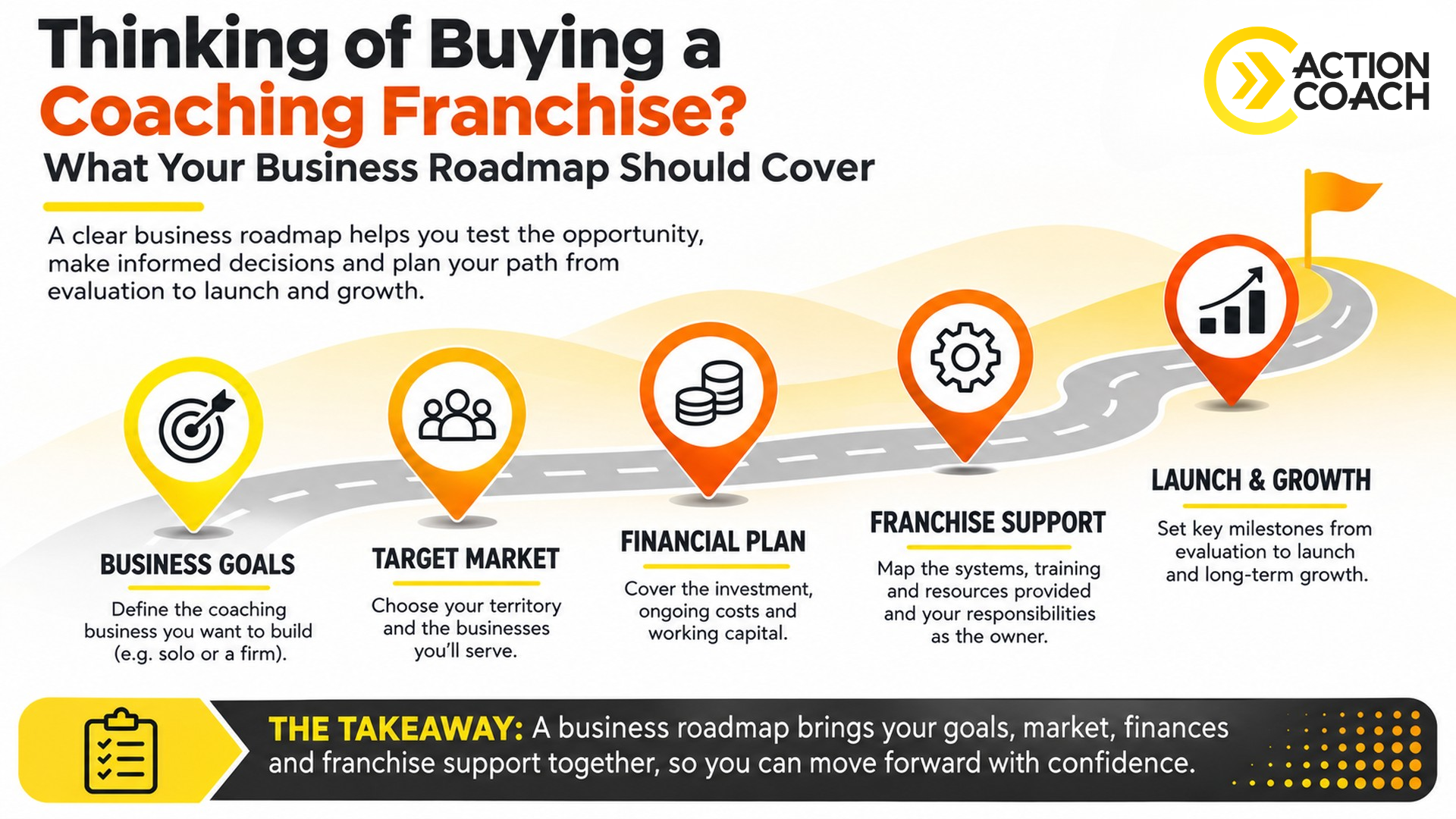
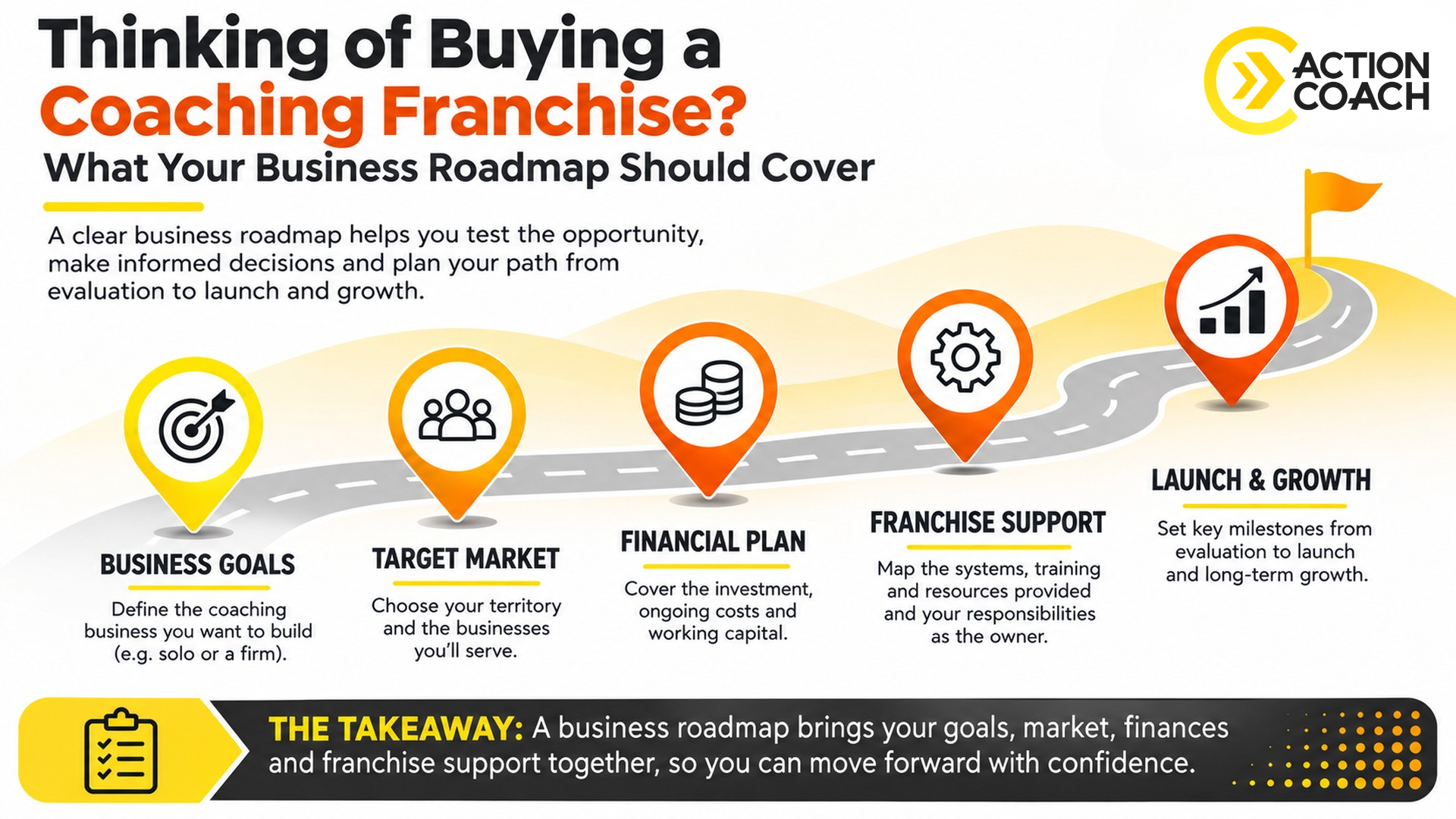
Buying a coaching franchise is a bigger decision than choosing a brand. You need a clear view of what you want to build, how you will fund the launch, who you plan to serve and how the franchise system will support you.
That is where a business roadmap helps. It brings those decisions together before you commit, giving you a practical way to test whether the opportunity fits your goals, resources and market while setting out the milestones that could take you from evaluation to launch and growth.
It should not replace a formal business plan. Instead, use it as a working framework to decide what needs to happen, in what order, and where ActionCOACH's systems and support fit into the picture.
Key takeaways before you build your business roadmap
- A business roadmap should clarify what kind of coaching business you want to build, who you plan to serve and what resources you will need to launch it.
- Your territory, target market and approach to winning clients should be considered together rather than planned in isolation.
- Financial planning should cover more than the initial investment, including ongoing commitments and sufficient working capital while the business develops.
- A franchise gives you an established framework, but the roadmap should still distinguish between the support provided by the franchisor and the decisions you remain responsible for as the owner.
- Treat the roadmap as a working document. Early assumptions should be reviewed as real market, client and financial information becomes available.
With an ActionCOACH franchise, your business roadmap does not start from a blank page. We provide an established coaching framework, training, territory structure and ongoing support, giving you more structure from the outset. That means your roadmap can focus less on inventing the business model and more on how you will apply it in your market: which clients you want to serve, how you will build local demand, how much capital you need and how you want the business to develop over time.
That still leaves important decisions with you as the franchise partner. The value of the roadmap is in bringing the franchise system and your own commercial plan together, so you can assess the opportunity against your goals, resources and territory before committing.
What should a business roadmap cover before buying a coaching franchise?
At its simplest, a useful business roadmap should show what you want to build, who you expect to serve, how the business will be funded and what needs to happen before launch. It should also make clear where the franchise system supports you and where responsibility remains with you as the owner.
Start with the shape of the business. Are you planning to coach clients yourself for the foreseeable future, or do you eventually want to build a firm with additional coaches and support staff? That decision affects staffing, territory, capital and the systems you will need.
From there, look outward. Your business roadmap should connect the territory and target market with a realistic approach to finding clients. It should also account for startup investment, ongoing operating requirements and enough working capital to support the business while it develops.
Then map the support we provide against the work you will still need to lead locally. Training, systems, marketing resources, technology and wider network support can give the business structure, but the roadmap should show how you intend to put those resources into practice.
Should you start a coaching franchise solo or build a coaching firm?
The answer should be more specific than 'a successful coaching business'. Your roadmap needs to describe the role you want to play and the kind of operation you want to create over time.
You may intend to begin as the main coach, concentrating first on building a client base and learning how the local market responds. Alternatively, your longer-term aim may be to build a coaching firm with additional coaches and support staff. Our franchise model supports both paths, and our franchise material encourages partners to consider building a team as the business develops.
Whichever route you choose, the implications for the plan are different. A solo-led business places more emphasis on the owner's selling, coaching and time capacity. A firm-building model requires earlier thinking about recruitment, leadership, quality control and the point at which additional people become commercially justified.
For that reason, the roadmap should describe the direction without pretending that every future decision can be fixed in advance. Its purpose is to make the ambition concrete enough to test against territory, capital and likely operating demands.
How do you choose a territory and target market for a coaching franchise?
Within our territory-based model, your franchise territory defines the geographic area in which you can build your local presence. The territory itself does not decide who your best prospects will be or how you will reach them, so your roadmap should connect the geography with a practical view of the businesses you are most likely to serve.
Consider the mix of businesses in the area, the sectors where you already have useful experience or relationships, and the kinds of owners or leadership teams you are best placed to engage. That does not mean locking yourself into one niche before you begin; it means giving your launch activity enough focus to be measurable.
That focus should also shape client acquisition. Rather than listing every possible marketing channel, set out how you expect prospects to discover you, how you will start conversations and how you will judge whether the activity is working. We provide marketing and sales systems and supporting resources, but local execution still needs to reflect your territory and the way you intend to build the business.
That gives the roadmap a practical role in decision-making. If the market response differs from your assumptions, you have a clear starting point for what to review rather than simply adding more activity.
What costs should you include in a coaching franchise business roadmap?
Financial planning deserves its own section because a viable franchise needs more than the initial franchise fee. Our investment varies by region and model, and you also need to consider ongoing fees and working-capital requirements.
A practical business roadmap should distinguish between:
- Initial investment and launch costs associated with entering the franchise system.
- Ongoing franchise, marketing or operating commitments that continue after launch.
- Working capital to cover normal business costs while the client base develops.
- Planned spending on local marketing, networking or staffing where relevant.
- A contingency for costs or slower-than-expected client acquisition.
In other words, the roadmap does not need to replace a formal financial model or lender-ready business plan. Its role is to show where the main financial pressures sit, what assumptions need to be tested and which decisions may need to change if trading develops differently from expected.
Need to put real numbers against your roadmap? Our franchise investment varies by region and model. One of our franchise advisors can help you understand the investment structure, available territory and support relevant to your plans before you build assumptions into your roadmap.
What support does ActionCOACH provide, and what does the franchise partner still manage?
Your roadmap should distinguish between the structure provided by the franchise and the responsibilities that remain with you as the owner. We provide training, coaching methodology, business systems, marketing assets, technology, territory rights and access to local and wider support. Startup support comes primarily through the local Master Franchise partner, where that structure applies.
You remain responsible for putting that framework to work in your market: developing client relationships, managing cash flow, leading any people you employ and deciding when the business is ready to grow. If client acquisition is the immediate priority, our sales and marketing systems can inform your next actions. If you intend to build a firm of coaches, your roadmap should also identify when recruitment and management capability need to develop.
What milestones should a coaching franchise business roadmap include?
Once those responsibilities are clear, milestones help you judge when the business is ready for its next move. They should test progress rather than impose an arbitrary timetable.
Useful milestones might include completing initial training, activating your territory plan, launching early marketing activity, building a measurable client pipeline and reviewing when additional capacity or support becomes commercially justified.
As real trading data comes in, update the roadmap accordingly. Client response, marketing performance and capacity may all challenge your original assumptions. Treat the roadmap as a working baseline for making better decisions, not as a fixed prediction.
How do you know if an ActionCOACH franchise fits your business goals?
By this stage, the roadmap should make the opportunity easier to evaluate, not simply make the plan look more impressive. You should have a clearer view of the business you want to build, the market you plan to serve, the resources required and the support you would expect from the franchise system.
We provide a structured coaching franchise model with training, systems, territory rights, marketing resources, technology and ongoing support. You remain responsible for turning those resources into a viable local business and adapting the plan as real trading information emerges.
Once your roadmap has taken shape, speak with one of our franchise advisors to test it against the opportunity. You can discuss the franchise model, available territory, investment requirements and support structure, then refine your assumptions before making a commitment. The conversation should support your decision-making, not replace the work of deciding what you actually want to build.
