

Many coaching companies grow quickly at first because the founder controls sales, delivers the work, and manages client relationships directly. Early momentum feels strong because decisions move quickly and quality remains consistent. Over time, that same concentration of responsibility creates dependency.
When acquisition and delivery rely on one person’s capacity, growth slows because output cannot expand beyond available time. Coaching companies scale faster when leaders design structured systems that make performance transferable across people.
What Changes When Coaching Companies Build Systems?
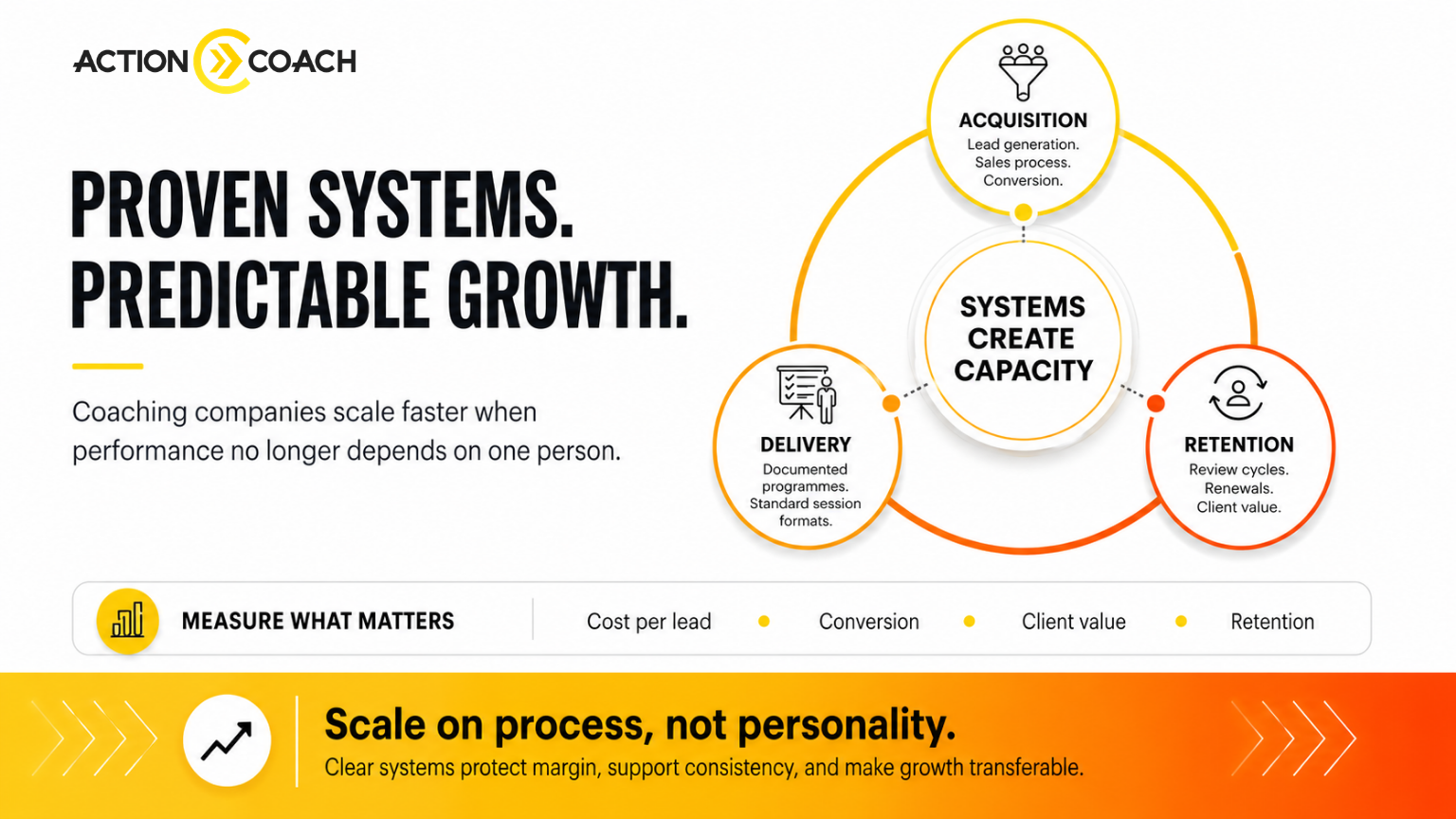
To scale, leaders need repeatable processes across acquisition, delivery, and retention.
Acquisition requires:
- A defined lead generation model.
- A structured sales framework.
- Measurable conversion benchmarks.
Delivery requires:
- Documented programme structures.
- Standard session formats that protect consistency.
Retention depends on:
- Scheduled review cycles.
- Renewal conversations grounded in performance.
Without these, growth depends on personal persuasion instead of a process.
When leaders document and enforce these systems, results become more predictable. Predictability allows hiring decisions, expansion planning and investment to happen with confidence instead of guesswork.
Performance measurement sits at the centre of this shift. Experienced operators treat metrics as commercial control tools.
Key indicators include:
- Cost per lead.
- Conversion rate.
- Average client value.
- Retention strength.
These metrics determine whether growth improves margin or quietly erodes it. Without visibility, marketing spend drifts, pricing loses discipline, and cash flow becomes unstable.
Margin protection follows the same logic. Independent operators often discount to win work or expand scope to satisfy clients. Revenue rises, but effective hourly return falls. Administrative complexity grows faster than profit. Leaders who standardise pricing, define programme boundaries, and track delivery time protect margin as scale increases.
ActionCOACH structures its franchise model around these same levers: defined acquisition systems, documented delivery methodology, performance tracking, and pricing discipline. Instead of building each component independently, franchisees operate within a framework designed to support predictable growth from the outset. You can see how these systems fit together in the overview of how franchising works.
Why Do Independent Coaching Companies Struggle to Build This Alone?
Many professionals who start their own coaching business focus first on client acquisition and delivery quality. Structure usually develops later, often after inconsistencies appear.
Building systems from scratch takes time. Sales frameworks require refinement. Pricing discipline develops through trial. Delivery processes evolve through mistakes. During that period, revenue can fluctuate, and expansion slows.
Professionals who want to become business coaches often underestimate how quickly operational complexity increases once growth begins. What works with five clients can strain with twenty. What feels manageable alone becomes difficult to replicate across a team.
The challenge is not capability. It is building a structure strong enough to carry scale without constant oversight.
Do Franchise-Based Coaching Companies Scale More Predictably?
Franchise-based coaching companies operate inside pre-built commercial frameworks. For those evaluating a franchise business coach model, the depth of that framework determines how quickly stability can be achieved.
Instead of designing acquisition funnels, pricing structures, and delivery methodologies independently, franchisees adopt defined systems from the outset. This can shorten ramp-up time and reduce early-stage trial and error.
ActionCOACH’s franchise model centres on documented methodology, structured training, and measurable standards. Franchising provides a structure in which a franchisor supplies systems and oversight while franchisees execute within defined commercial parameters. Its system covers lead generation, programme delivery, and accountability mechanisms, as outlined in its explanation of how franchising works.
This structure reduces early experimentation and limits pricing or delivery inconsistencies that often slow independent operators. For a more detailed view of how that framework operates in practice, the franchise process and support structure outline the commercial model step by step.
When coaching companies operate within a defined franchise structure, leaders rely on system execution rather than improvisation to drive growth.
What Does Faster Scaling Actually Mean?
Faster scaling does not mean aggressive expansion without discipline. It means reaching stable acquisition sooner, maintaining consistent delivery as client numbers grow, and protecting margin as revenue increases.
ActionCOACH integrates training, marketing infrastructure, and performance tracking into its franchise model from the outset. Operators begin with systems in place instead of adding them reactively after mistakes. That structural head start reduces volatility and improves early-stage stability.
Is a Proven System Necessary for Long-Term Growth?
Experience alone does not create scalability. Many coaching companies remain small because revenue tracks personal effort and stalls when complexity increases. Long-term growth requires documented systems and measurable standards that extend beyond the founder.
ActionCOACH built its franchise model around those principles. Instead of constructing every element independently, franchisees operate within a defined commercial framework designed for expansion across territories and teams.
Any franchise agreement or franchise contract should clearly outline territory rights, performance expectations, and support obligations before you commit. If you want to assess how a structured model could accelerate growth, you can speak with an ActionCOACH advisor. The discussion is exploratory and without obligation and allows you to evaluate territory structure, system design, and commercial expectations before making a decision.
Coaching companies scale when leaders commit to disciplined execution supported by structure. The decision is whether to build that structure independently or operate within one that has already been designed for replication.
