

Deciding on a business coaching franchise is less about brand and more about whether the organisation behind it can support consistent delivery at scale. The coaching company sets the operating model, standards, and level of support you will rely on once you begin trading.
What follows sets out how to assess coaching companies when choosing a franchise, with a focus on delivery structure, ongoing support, and evidence of repeatable performance. The goal is to reduce risk and avoid shortlisting a model that looks strong on paper but struggles in practice.
What makes coaching companies different when they operate as franchises?
A coaching company that operates as a franchise provides a framework that allows multiple coaches to deliver consistent results under the same operating model. That framework and your individual coaching skill together determine your results.
In a franchised environment, the coaching company must support predictable client acquisition and provide a coaching methodology that works across markets, while also enabling the coach to operate as a business owner. Understanding how franchising works helps clarify what structure and support should look like in practice.
Some providers deliver strong coaching but struggle to transfer that capability across a network, which often only becomes obvious after several franchisees are active. Others rely too heavily on individual personalities, which makes results hard to replicate.
Does the coaching company have a proven franchise delivery model?
Look for programmes with a clear structure, defined outcomes, and agreed milestones that coaches can apply consistently, because this reduces variation between franchisees and lowers early delivery risk. That structure should allow different coaches to deliver similar results without rewriting the process each time, which reduces risk and improves execution in the early months.
A clear delivery model limits overcustomisation, which is where consistency often starts to erode. When every engagement becomes bespoke, results depend entirely on individual effort.
How do coaching companies support franchisees beyond initial training?
Initial training matters. It does not determine long-term performance. The real test begins after the first few months.
Once franchisees begin working with real clients, they face new pressures. These often include balancing delivery with sales activity and handling difficult conversations while maintaining consistency as demand increases. Coaching companies that focus only on onboarding leave franchisees to work these issues out alone, which increases risk during the first period of client delivery.
Stronger providers offer ongoing development and regular review points, alongside access to experienced peers. This helps franchisees correct issues early and maintain consistent performance after the initial phase. One UK-based example is the experience of ActionCOACH Sheffield, which highlights how ongoing support and peer accountability can shape performance beyond initial training. The franchise places a strong emphasis on shared cultural standards, particularly around excellence and collaboration, which influences how coaches operate day to day. That focus has translated into active community engagement and structured peer activity that reinforces consistent delivery while still allowing the franchise to respond to the specific character of its local market.
Many franchise buyers only realise what matters after they have already shortlisted a coaching company. Talking through the evaluation criteria early can help you avoid late-stage reversals and clarify whether a model will support you beyond the launch phase. You can speak with an advisor to test your assumptions before narrowing your shortlist further.
What role do systems and structure play in the success of a coaching franchise?
Systems support consistent execution and quality control, particularly when workload and decision volume increase. They reduce unnecessary decision-making and limit reliance on individual memory or motivation.
Clear systems for client onboarding, session flow, progress tracking, and reviews free up time for client-facing work and delivery improvement. As workload increases, these systems make performance easier to sustain without increasing working hours.
How should coaching companies help franchisees build a scalable client base?
A business coaching franchise only works if franchisees can build clients consistently. When you evaluate coaching companies, look closely at how they support both acquisition and retention.
Models that rely solely on one-to-one coaching often limit growth and increase operational pressure on the coach as demand builds. More scalable approaches usually combine individual work with group programmes and structured follow-on services.
Retention and renewals often matter more than constant new sales, because they stabilise revenue and reduce pressure on acquisition activity. Providers that manage these areas deliberately tend to produce more stable results for franchisees.
What evidence should established coaching companies be able to show?
Organisations make many claims, but evidence requires verification over time. Look beyond individual success stories.
Useful indicators include how long the company has operated and the maturity of its franchise network, as well as whether results remain consistent across different regions. Clear standards, scorecards, and review rhythms show how organisations monitor performance instead of assuming it.
Client outcomes can also provide supporting evidence when they show repeatable application of the coaching model. For example, the published Urban Clean case study illustrates how structured coaching frameworks supported operational growth while reducing reliance on the founder.
How do you assess cultural fit and long-term alignment with a coaching company?
Technical capability alone does not make a coaching franchise work. Cultural alignment matters because you will operate within that environment for years.
Assess how accountability works in practice, because this determines how standards hold up once initial enthusiasm fades. Some coaching companies emphasise autonomy but offer little challenge when standards slip. Others set clear expectations and follow through consistently. Observed behaviour matters more than formal value statements.
What common mistakes do people make when comparing coaching companies?
Many franchise buyers compare coaching companies using surface-level criteria. Common mistakes include overvaluing brand recognition, underestimating delivery structure, and assuming independence brings flexibility.
Another frequent error is confusing personal coaching ability with business scalability. Being a strong coach does not guarantee you can build a sustainable coaching business without a supporting framework.
The organisation you choose will influence how you operate, how the business develops, and the level of control you retain.
How do you narrow your shortlist before making a decision?
Once you understand the differences between coaching companies, narrowing your shortlist becomes more practical and less driven by surface-level signals.
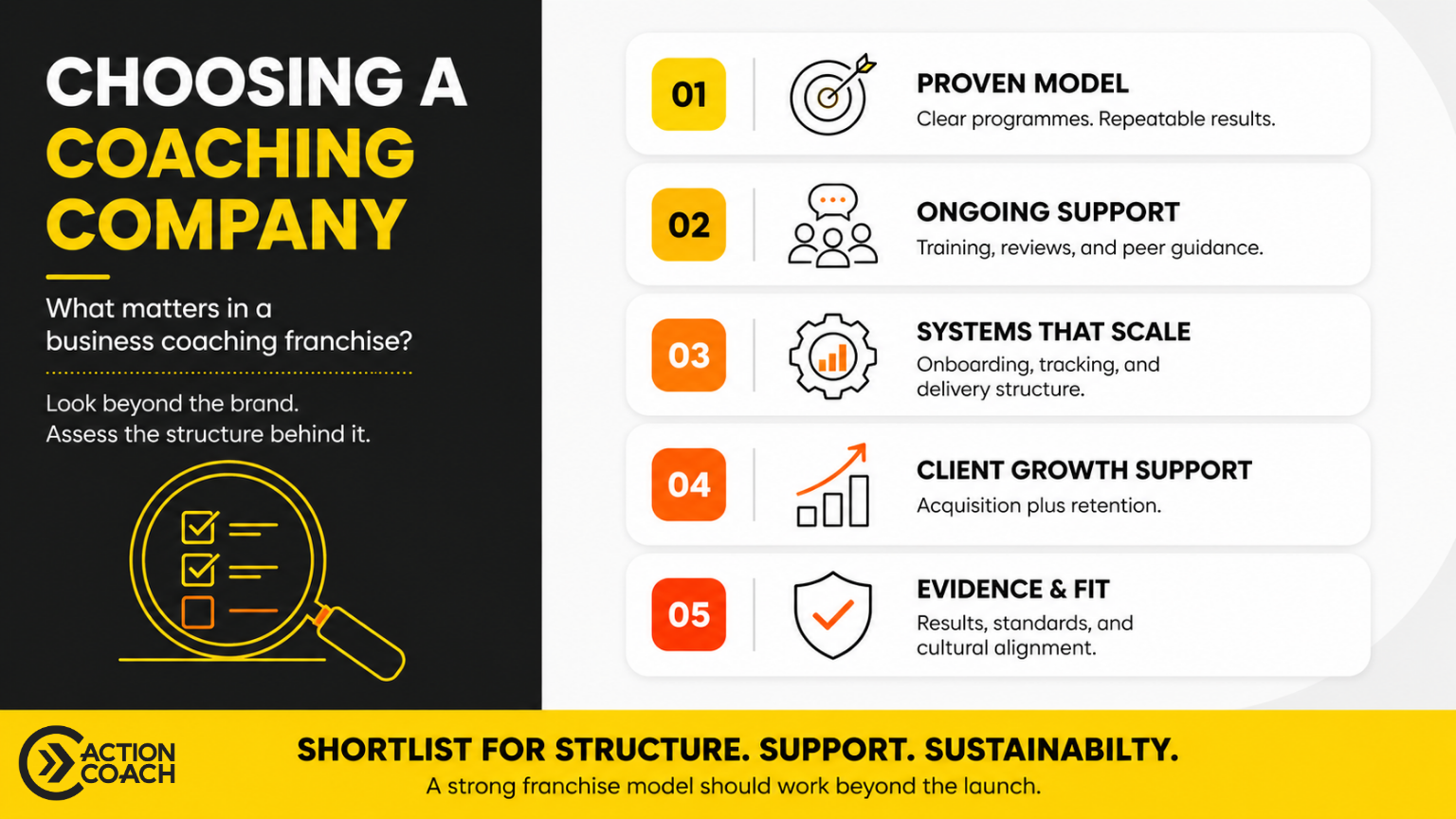
Focus on the delivery structure, ongoing development, and post-launch support that affect performance after launch. Clarify how each company supports franchisees after recruitment, then assess whether expectations align with how you want to operate as a business owner.
Making a confident franchise decision
Choosing between coaching companies is a decision about structure, support, and sustainability. If you want to test your assumptions before committing further, a structured conversation can help you assess fit and operational expectations.
You can explore how franchising works and then speak with an advisor to discuss whether a business coaching franchise aligns with your goals.
