

Buying a franchise reduces some of the uncertainty that comes with starting from scratch, but risk does not disappear.
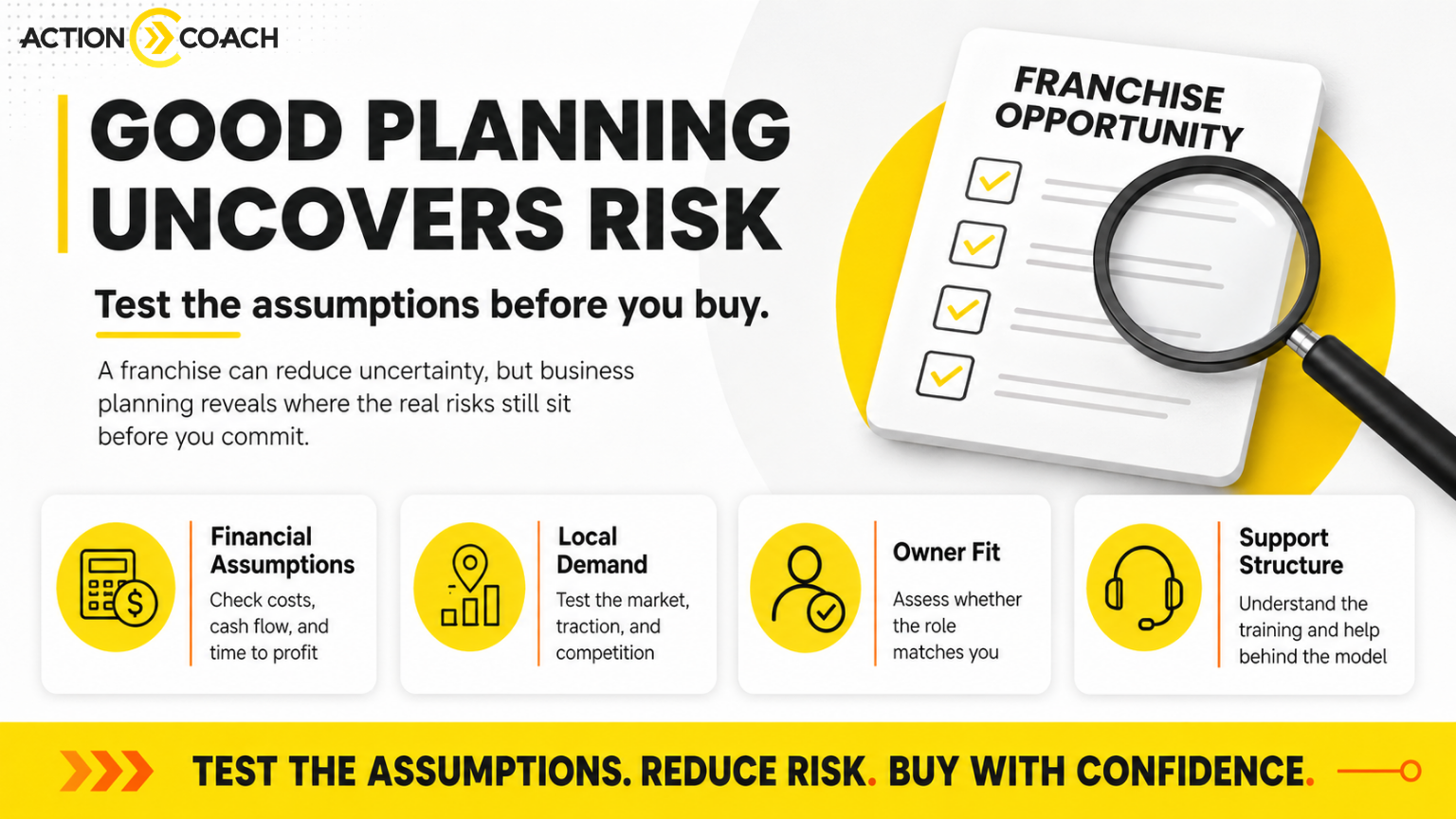
Good business planning helps you spot the assumptions that may not hold up before you commit serious time and money. Before you buy, it helps you look past the headline appeal of the franchise and assess the numbers, the local market, and what the role will really demand from you.
At ActionCOACH, we often see this shift happen early. Buyers like the headline model, then start asking harder questions once they look at what the role actually involves.
Why do you need business planning before buying a franchise?
Business planning matters before buying a franchise since it provides the opportunity to stand up to proper scrutiny. That helps you spot weak assumptions before they turn into expensive mistakes.
At this stage, buyers often focus on the upside. The model looks established. The support sounds strong. That may all be true. It still does not tell you how the opportunity holds up once you start testing the assumptions.
A good planning process forces a few important questions into the open: do the numbers stand up, is the local opportunity strong enough, does the role suit you, and what support will you need in practice?
That is why operational forecasting should sit inside franchise due diligence. It turns interest into something more disciplined.
What financial risks can business planning uncover?
This is usually where the numbers start to stretch.
A lot of franchise buyers focus on headline costs and earnings, but that hardly gives a complete picture. The real question is whether the opportunity works financially for you once the early costs and slower ramp-up start to bite.
It can uncover risks such as:
- underestimating start-up and working capital needs
- overestimating how quickly revenue will build
- assuming profitability will arrive sooner than it realistically will
- overlooking ongoing costs tied to marketing, hiring, training, or local operations
A franchise can still be a good opportunity, but it can become difficult if the financial expectations are weak from the start. Planning helps you catch that before you commit.
How can business planning reveal market and demand risks?
A proven franchise model does not mean every territory will perform in exactly the same way.
Business planning helps you test how the opportunity may work in the market you are actually entering, not the one you imagine on a good day.
It may reveal risks such as:
- assuming demand is stronger than it really is
- misunderstanding how long it may take to win traction locally
- underestimating local competition or market education needs
- relying too heavily on brand strength without thinking enough about local execution
This is not about trying to prove the franchise model wrong. It is about making sure your local assumptions are grounded in reality before you start treating them as fact.
What operational risks can business planning uncover before launch?
Some of the biggest risks are operational, not only financial.
Before buying a franchise, buyers often focus on ownership and not enough on what the role may actually involve. Planning forces that into the open quickly.
For example, it can reveal where you may be underestimating:
- The amount of sales activity needed early on
- The importance of consistent business development
- The discipline required to follow proven systems properly
- The time needed to build a pipeline, relationships, and credibility
- The operational demands that sit behind launch and early trading
Buyers sometimes assume that a proven model will do more of the work for them than it really can. A strong franchise gives you structure, support, and a tested route. You still need to execute consistently, and planning helps you see that before the role catches you out.
Can business planning show whether the franchise actually fits you?
Yes. This is often where buyers start seeing the fit more clearly.
Some risks are not about the model itself. They are about fit. Business planning can show whether the opportunity actually suits your strengths, expectations, and working style.
It may bring issues to the surface, such as:
- expecting a more passive model than the role really offers
- underestimating the level of client-facing or sales-led activity involved
- misjudging how much self-discipline the business will require
- overlooking whether the long-term role matches what you want from ownership
Poor fit can create friction even inside a strong franchise model. Planning helps you spot that early, before excitement hardens into commitment.
How does business planning reduce risk when comparing franchise opportunities?
Business planning gives you a stronger way to compare opportunities.
Without it, franchise comparisons stay too close to brochure-level messaging. One opportunity may look attractive because of the market, another because of the support, and another because of the earnings story. Planning helps you test what sits underneath those claims.
That makes it easier to compare:
- cost structure
- time to traction
- support and training depth
- local market potential
- role demands and expectations
Planning helps you compare the assumptions underlying the offer, which usually leads to better decisions.
What should a franchise business plan include before you buy?
A stronger planning process is realistic, specific, and honest about what still needs proving.
It should include:
- grounded financial assumptions
- a realistic view of early trading and cash flow
- clear thinking on local market demand
- an honest picture of the owner's role
- a proper understanding of training, support, and launch expectations
- space to challenge assumptions before they become commitments
This part of the process should show you where the gaps are. It should show you what still needs proving and where your answers still feel too thin. The Learning Center is useful here because it gives you more material to test your assumptions against before you move forward.
How does ActionCOACH help reduce risk before you buy?
This is where the franchise structure either gives you confidence or leaves you with more questions.
ActionCOACH gives franchise buyers more than a brand name. It gives you a proven coaching framework, structured onboarding, and a clearer view of what the business actually involves. That matters because you can evaluate the opportunity with more substance, not just react to marketing language. It also makes it easier to judge what support you will really have once you move past the sales process.
If you are considering ActionCOACH, you can assess the opportunity with better visibility into:
- The role you would be stepping into
- The training and support available
- How the model works in practice
- What the path from launch into growth may look like
That is why pages like How Franchising Works and the Learning Center are useful during evaluation.
How does business planning help you buy a franchise with less risk?
Good business planning should uncover risk before you buy, not after you have already committed time and money.
It gives you a more disciplined way to test the numbers and challenge the assumptions, so you understand what the role will really require from you.
The right franchise model can reduce uncertainty, but only when you understand what you are buying and what it will require from you. To discuss the right next step, speak with an advisor.
