

How Does Strong Time Management Support Franchise Growth and Consistency?
Franchise growth does not fail because of ambition. It fails when execution becomes inconsistent across locations and teams. One of the most common causes is poor time allocation at the owner and operator level.
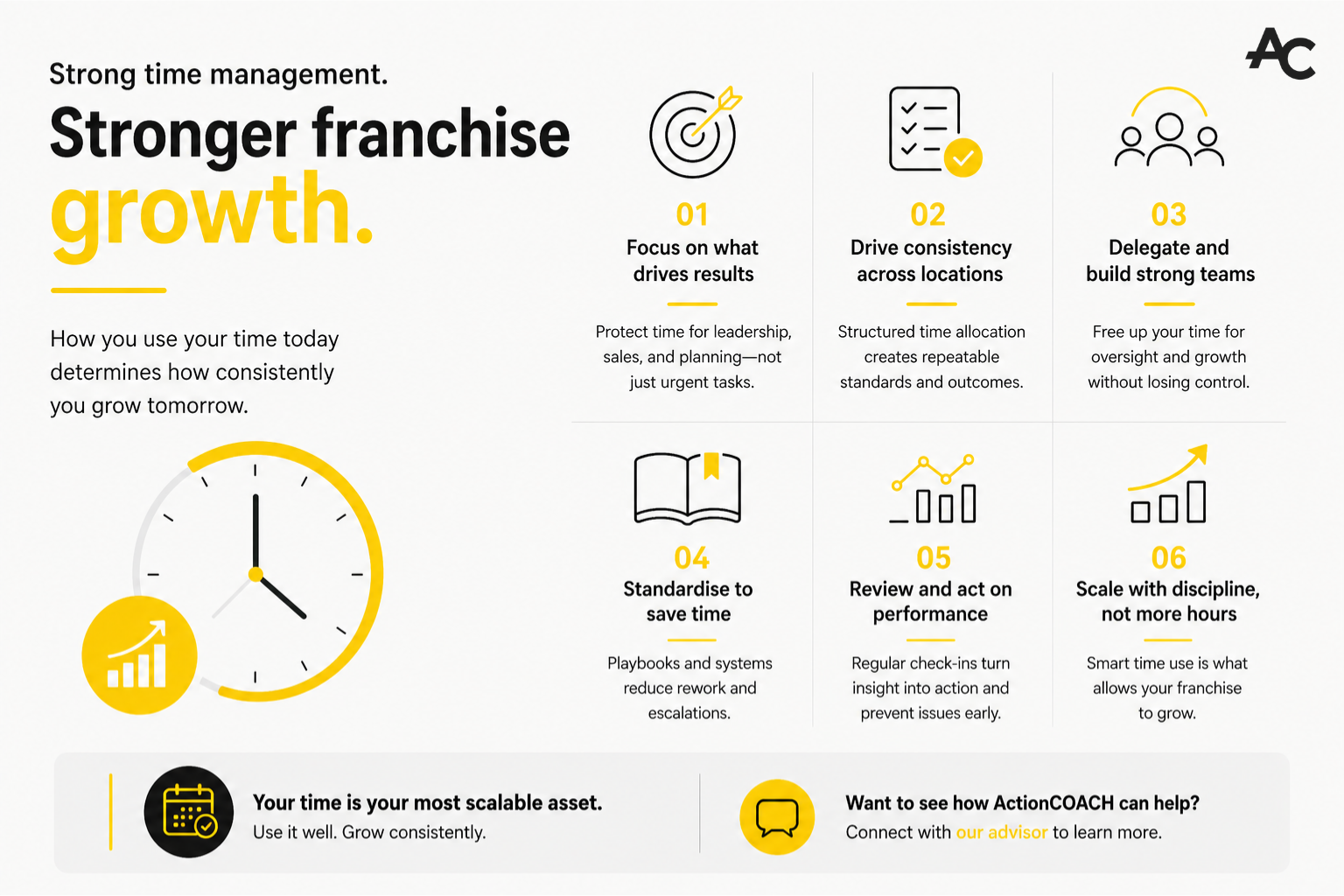
Strong operational time management for franchise owners focuses on repeatable structures that support consistent performance and maintain standards as the business grows. These time management skills for franchise growth help owners balance leadership, delivery, and oversight as the business scales. For franchise owners and prospective franchisees, the way time is used is a clear indicator of whether a franchise model can scale without creating owner dependency.
Why Does Time Management Matter More in Franchising Than Independent Businesses?
Independent businesses can tolerate variation. Franchises cannot, particularly when owners must deliver consistent outcomes across locations using the same operating model. Understanding how this structure works in practice is central to how franchising works and why consistency matters at scale.
Without structured control over how time is allocated, franchisees prioritise urgent tasks over important ones. Senior time is then absorbed by issues that should not escalate, while sales activity and quality control receive less attention.
When franchise owners allocate their time deliberately, they protect capacity for leadership, revenue activity, and planning, which reduces reactive decision-making as the business expands. This is where practical time management for franchise owners directly supports controlled growth.
How Does Time Allocation Drive Operational Consistency Across Franchise Locations?
When franchise owners decide in advance how they spend their week, they create consistency across locations. This only works when the franchise operates with a shared direction and priorities, anchored in a clear vision, purpose, and mission. This approach reflects effective time management in franchising, where consistency depends on planned use of owner time rather than personal effort. Fixed time blocks for leadership, review, sales activity, and planning reduce variation and allow teams to operate to the same standards.
If you are assessing whether a franchise model provides this level of structure and support, it can be useful to discuss how time discipline is embedded in practice. You can speak with an ActionCOACH advisor to explore how the franchise approaches operational rhythm, owner time allocation, and scalability.
How Does a Franchise Owner’s Role Change as the Business Scales?
As a franchise grows, the owner’s role changes, particularly in how time is allocated.
Early-stage franchisees often spend most of their time handling escalations and resolving operational constraints. As the business grows, owners must shift their focus toward leadership and oversight.
Clear control over how the owner spends time reduces day-to-day dependency on the owner and supports consistent performance review.
Use Timeboxing to Protect Growth Activity From Day-to-Day Noise
Important work is often postponed in favour of urgent operational tasks. Timeboxing addresses this by assigning priority activities to fixed calendar blocks.
In a franchise setting, timeboxing is particularly effective for protecting sales activity, quality control, compliance checks, and financial review.
When activities sit in fixed time slots, they are less likely to be postponed, improving consistency and creating capacity for planned growth without increasing working hours.
Time Discipline Supports Measurable Performance
Franchise systems depend on disciplined use of data. Owners need to review and act on that data at the right intervals.
When franchisees delay or skip reporting, reviews, and performance tracking, issues surface late, and progress becomes harder to replicate. Consistent review supports earlier intervention.
Over time, this regular review cycle helps franchise owners understand which activities produce results and which consume time without adding value. This insight allows owners to adjust how time is spent, reinforce what works across locations, and address emerging risks before they affect service quality or financial performance.
How Does Delegation Improve Time Use as a Franchise Grows?
As franchises grow, problems with time use often point to delegation gaps rather than a lack of effort.
Many franchise owners stay involved in tasks others could manage because escalation feels faster than waiting for systems or training. Over time, this creates owner dependency and limits growth capacity.
A structured approach to delegation helps owners identify which activities require their input and which can move to the team. Clear roles and operating design then free up owner time for leadership and oversight without increasing personal workload.
Why Do Standardised Playbooks Matter for Time Control in Franchising?
Franchise consistency relies on reducing the amount of time spent re-deciding how core tasks should be done.
Standardised playbooks and operating procedures play a direct role in time control by shortening decision cycles and limiting unnecessary escalation back to the owner. When expectations are documented clearly, teams spend less time seeking clarification or escalating routine issues.
This supports faster onboarding, more consistent service delivery across locations, and fewer interruptions to the owner’s time. In growing franchise networks, standardisation saves time and supports consistent execution at scale.
How Franchise Coaching Reinforces Time Discipline at Scale
Franchise coaching focuses on aligning how franchisees use their time with the commercial objectives of the model. This alignment is reinforced through ongoing franchise education and learning resources that support consistent application across the network. Within ActionCOACH, this means identifying high-value activities, setting clear weekly and monthly structures, delegating without losing control, and maintaining consistency as the business scales.
Coaching also plays a practical role in helping franchise owners adapt their time use as conditions change. As teams grow, markets shift, or new services are introduced, the way owners allocate time often needs to be adjusted. Regular coaching conversations provide a structured forum to review what is taking up time, what should be deprioritised, and where greater focus is required to support growth and performance.
Maintain Consistency With Short, Structured Performance Check-Ins
Disciplined use of time supports consistency when franchise owners review performance regularly.
Short, structured check-ins give owners visibility on progress without relying on informal updates or reactive problem-solving. When these reviews focus on a small number of agreed measures, issues surface earlier, and corrective action happens sooner.
This approach reduces the risk of performance drift as the franchise grows.
Time Management as a Competitive Advantage in Franchising
In competitive franchise markets, disciplined use of time helps franchisees grow without increasing hours worked and maintain standards as teams expand. Applied correctly, time management for franchise growth becomes a practical advantage rather than a productivity exercise.
For prospective franchisees, understanding how a franchise supports time discipline, delegation, and consistency in practice is an important part of the evaluation process. If you would like to explore how ActionCOACH structures these elements within its franchise model, connect with our advisor!
